
Martin Luther King Day
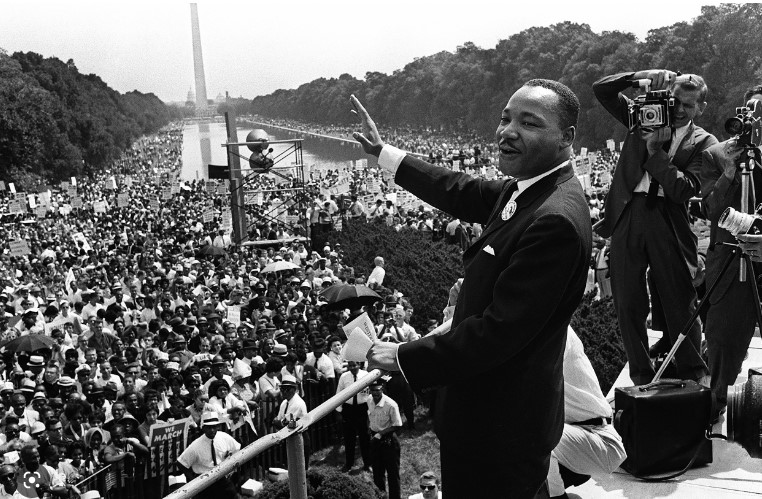
Today the United States celebrate Martin Luther King Jr. Day. This holiday marks the birthday of Martin Luther King and is observed on the third Monday of January each year.
Born in 1929, King was the chief spokesperson for non-violent activism in the 1950’s Civil Rights Movement, which protested racial discrimination in federal and state law. The campaign for a federal holiday in King’s honour began soon after his assassination in 1968. President Ronald Reagan signed the holiday into law in 1983, and it was first observed three years later.
10 things to know about Martin Luther King:
1. King was born into a house of religion and activism
Micheal (later Martin Luther) King Sr. was a devout Christian and Baptist minister. In fact, Michael was so impressed by the 16th century Protestant Reformer, Martin Luther, he changed both his and his son’s names. King’s father was also a civil rights activist, leading hundreds of Black Americans protesting lack of voting rights to Atlanta City Hall in 1936.
2. King started university at 15 years old
In 1944, as many young Black men were enlisted into the war depriving universities of their students, 15 year old King started at Morehouse College – an historically all-Black and male school. He graduated at the age of 19 with a BA in Sociology.
King then decided to enter the ministry, where he felt he could best answer his “inner urge to serve humanity”. He would later go on to achieve a PhD in theology in 1955, becoming Dr. Martin Luther King Jr.
3. He was married to Coretta Scott
Coretta met King while he was studying in Boston. In 1953 they were married in Alabama and would go on to have 4 children together.

Despite being attracted to her involvement in civil rights activism, after they married King restricted Coretta’s involvement in the movement. He believed her energy was best spent as a housewife and mother, demonstrating how the intersection of race and gender shaped Black women’s fight for civil rights.
4. He advocated for non-violent activism
Inspired by Biblical stories of Jesus ‘turning the other cheek’ and the Indian independence activist Mahatma Gandhi’s principle of ‘satyagraha’, King believed civil disobedience and non-violence were the only ways to sustainably advance the cause of Black Americans.
5. King led the 1955 Montgomery Bus Boycott
Only in his twenties, King took the leading role in the bus boycott that began with Rosa Parks refusing her bus seat to a white passenger. His role gained him so much media attention that King’s house was threatened with bombing. The boycott lasted 385 days, ending when the US District Court ruled that racial segregation was not allowed on Montgomery buses.
6. King was arrested 29 times

During the Birmingham campaign of 1963, King was arrested for the 13th time – on purpose. Led by King, the Southern Christian Leadership Conference (SCLC) occupied public spaces to protest segregation, hoping that mass arrests would provoke negotiations with officials.
7. He was one of the best orators in modern history
On 28 August 1963, between 200,000 and 300,000 people marched on Washington DC advocating for the civil and economic rights of Black Americans. King was the event’s final speaker and gave his “I have a dream” speech on the steps of the Lincoln Memorial, describing his dreams of equality within a land built upon slavery and inequity.

(Leaders of the Washington DC. March posing in front of the statue of Abraham Lincoln at the Lincoln Memorial, 28 August 1963. Martin Luther King, Jr. looks directly at the camera).
The March on Washington for Jobs and Freedom was one of the largest political rallies in US history and was influential in passing the Civil Rights Act of 1964.
8. King opposed the Vietnam War
Fearing it would hinder the civil rights campaign, King had to be urged by the SCLC to speak out on the war in Vietnam. Yet he vehemently opposed the conflict, arguing the war cost the United States not only too many lives but money that was better spent on welfare.
As he predicted, speaking out lost King valuable white supporters, including Lyndon Johnson and powerful publishers such as The Washington Post.
9. He was assassinated on Thursday 4 April 1968
King was fatally shot by James Earl while standing outside his room at the Lorraine Motel in Tennessee. Rushed to hospital, King died later that day. With the news of his death, uprisings erupted across the country, particularly in Washington DC, Baltimore, Louisville, Kansas City and Chicago. These events came to be known as the Holy Week Uprisings and continued into May 1968.
10. King’s assassination spurred the passing of the landmark 1968 Civil Rights Act and a legacy of civil rights activism
Combined with the pressure of the uprisings and decades of campaigning, on 11 April the Civil Rights Act was passed into law by President Lyndon Johnson, signalling a move towards ending racial discrimination.
In 1983, President Ronald Raegan created a federal holiday honouring King for his commitment to justice and equal rights for all. Martin Luther King Jr. Day was observed for the first time on January 20, 1986.
Interesting reading. Thank you.
You’re welcome Vivienne!